
Gum Recession and Gum Grafting
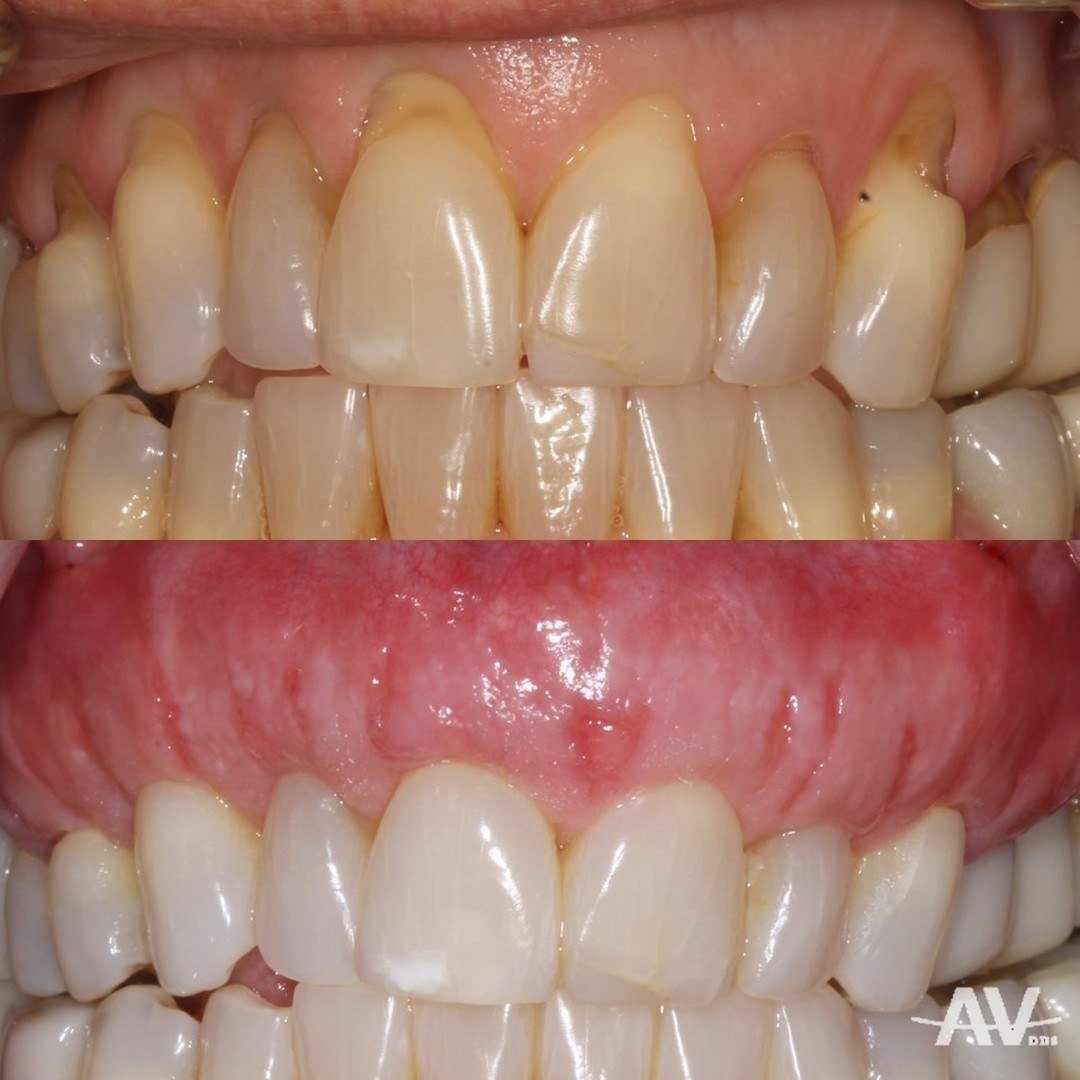
Receding gums leave the root of a tooth exposed. The root is sensitive, it decays more easily than enamel, and the tooth starts to look longer than the one beside it. A graft covers the root and thickens the gum so it stops pulling back. Most grafts use a small piece of your own tissue from the palate, or a processed donor graft instead. The site looks settled in two to three weeks and finished in six to eight.


“For almost 10 years, my dentists had urged me to get a gum graft for my deep gum recession on my lower front teeth. I was avoiding it due to accounts I had heard of its being a very painful process. … I have to say, I wish I had done it sooner and caught the gum recession before it got so bad.”
“Dr. Andrew Verrett did an amazing job with my gum graft procedure. Him and the amazingly supportive staff were very nice in answering questions, making me feel comfortable throughout the whole process, and were super professional. If anyone has fears of stuff like this, I highly recommend coming to this place.”
Why Gums Recede
Gums recede for a handful of reasons, and most people have more than one. Thin tissue to begin with. Brushing hard. Braces that moved a tooth past the bone it sits in. A frenum pulling on gum that is already thin. Old gum disease. Whatever started it, the gum does not grow back on its own once the root is showing.
That matters more than it looks like it does. An exposed root is sensitive to cold, and it decays more easily than enamel does. Thin gum tends to keep pulling back. A tooth that looks longer than its neighbor changes a smile. It matters around an implant too, where thin tissue lets the gray show through and makes the area harder to keep clean. The American Academy of Periodontology states that root coverage procedures are designed to cover exposed roots, reduce further gum recession, and protect vulnerable tooth roots from decay.
A Gum Graft in Austin: The Short Version
For anyone comparing offices, here is what a gum graft at Austin Periodontal Associates actually involves.
- The visit. Forty-five to ninety minutes in the chair, numb throughout, with sedation if you want it. Most patients have it done on a morning and are at home by lunch.
- The week after. Soft food for a week, the palate tender for about that long if your own tissue was used, sutures out at two weeks. Most people are back at work within a day or two. Recovery day by day is the honest account.
- How it looks. Settled by six to eight weeks, and it keeps maturing for months. Because a connective tissue graft sits under the gum you already have, it matches your color.
- How long it lasts. In a twenty-year follow-up by Pini Prato and colleagues in the Journal of Periodontology, 45 connective tissue grafts on upper teeth averaged 74 percent root coverage at one year and 68 percent at twenty. The results held best where the tissue between the teeth was intact, which is one of the things measured at your consult.
- What moves the result. Smoking most of all: an updated systematic review by Chambrone and colleagues found nonsmokers gained about 22 percent more root coverage than smokers after a connective tissue graft. After that, brushing habits.
- The cost. Estimated per tooth or per area, in writing, before anything is scheduled. The practice is out of network with every plan, files the claim for you, and has monthly payment plans.
- Who does it. Dr. Verrett, a board-certified periodontist, is the only doctor here. The person who examines you does the surgery and sees you at every visit afterward.
The Graft Types
Which technique Dr. Verrett uses depends on how much root is showing, how much firm gum is there to start with, and where in the mouth the work is. In the systematic review that Chambrone and Tatakis prepared for the AAP Regeneration Workshop, drawing on 234 included studies, connective tissue graft procedures produced the highest percentages of mean and complete root coverage and a significant increase in keratinized tissue.
- Connective tissue graft. A thin layer of tissue from under the surface of the palate is tucked beneath the gum, over the exposed root. This is the most predictable way to cover a root. The palate heals in two to four weeks. Langer and Langer described this subepithelial connective tissue graft in 1985, reporting an increase of 2 to 6 mm of root coverage across 56 cases over four years and attributing the result to the graft drawing blood supply from both the connective tissue bed beneath it and the flap laid over it.
- Free gingival graft. A small piece from the surface of the palate goes where the gum is too thin or missing altogether, usually on the lower front teeth. The goal here is a thick, tough band of gum more than coverage of the root. Sullivan and Atkins set out the principles of free autogenous gingival grafting in 1968, and the graft used today is still the procedure they described.
- Donor tissue graft. Processed human tissue does the job of the palate graft, so there is no second surgical site. It is used most often when several teeth are treated at once.
- Tunneling technique. Where the case allows, the graft slides in through small openings instead of a long incision. Fewer sutures, and an easier week afterward.
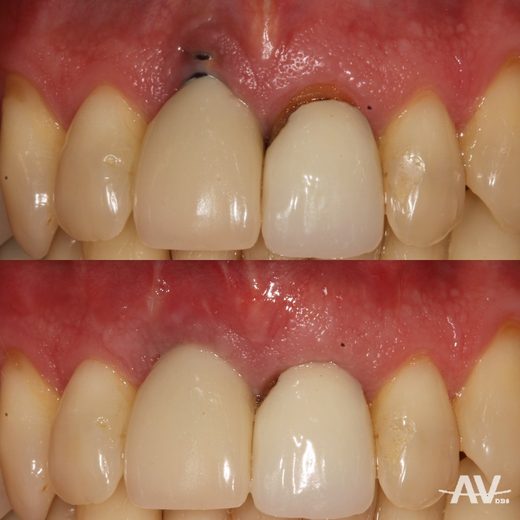
What Happens
- The consultation. Dr. Verrett measures the recession on each tooth, checks how much firm gum is left, and works out what caused it. The 2017 World Workshop classification, which Cortellini and Bissada set out for the American Academy of Periodontology and the European Federation of Periodontology, grades recession on those same terms: its severity, the dimension of the gum around it, whether the root surface is damaged, and whether the tooth is sensitive. It replaced Miller’s 1985 classification of marginal tissue recession, which described four classes of recession and was the most widely used system in periodontics for more than three decades. You leave with a written plan that says which teeth, which technique, and why.
- The procedure. Local anesthetic, and sedation if you want it. Somewhere between 45 and 90 minutes, depending on how many teeth are treated. Fine sutures hold the graft, and when the palate is used, a dressing goes over it.
- Healing. Soft food for a week. Do not brush the site, and do not pull your lip out to look at it. The sutures dissolve or come out at your two-week visit.
- Follow-up. Dr. Verrett sees you at two weeks and again at six to eight weeks. Your dentist gets a report after each one.
Recovery, Week by Week
- Days 1 to 3. Expect some swelling and mild soreness. Ice, over-the-counter pain relief, and cool soft food.
- Days 4 to 7. Most people are back at work and doing normal things. The palate is still tender.
- Week 2. Sutures come out. The graft looks a little swollen and pale, which is exactly how it should look.
- Weeks 3 to 8. Color and contour settle down. Gentle brushing resumes once the graft has been checked at two weeks. The final shape keeps maturing for a few months after that.
Cost and Insurance
Grafting is estimated per tooth or per area, and it is in writing on your plan before anything gets scheduled. Many dental plans reimburse part of soft tissue grafting when the recession is documented. We are an out-of-network provider, but we file your dental insurance claim on your behalf so you receive the reimbursement directly from your insurance company, and monthly payment plans are available. Insurance and financing.
If another office has already proposed a graft, bring the plan; a second opinion here is a measurement and a written plan you can compare line by line. Request a consult in North Austin, or call (512) 346-6097.
Frequently Asked Questions
Does a gum graft hurt?
You are numb for the procedure, and you can be sedated if you would rather. Afterward the grafted area is usually mildly sore. When tissue comes from the palate, that spot feels like a pizza burn for about a week, and it is the part most patients notice. Donor tissue skips the palate altogether.
My own tissue or donor tissue?
Your own connective tissue is the standard for covering an exposed root, and it gives the most predictable coverage. Processed human donor tissue avoids a second surgical site, which matters when several teeth are treated at once or when you would rather leave the palate out of it. Dr. Verrett recommends one based on how many teeth are being treated, how much root needs covering, and what you prefer.
What is the tunneling technique?
It is a way of sliding the graft into place through small openings instead of opening the gum with a long incision. Fewer sutures, and an easier recovery. It works well for a single tooth and for several teeth in a row with mild to moderate recession. Deeper recession usually needs the conventional approach to get full coverage.
Will the gum grow back on its own?
No. Gum tissue does not regrow over a root that is already exposed. Fixing the cause, which is usually hard brushing or simply thin tissue, keeps it from getting worse. Only a graft covers what is already showing.
How long does it take to heal?
Two to three weeks before the graft site looks settled, six to eight weeks for the final result. You will be on soft food the first week, and you will not brush the area until Dr. Verrett has checked it.
Can I be sedated for a gum graft?
Yes. Most grafts go comfortably with local anesthetic alone, but nitrous oxide, oral sedation, and IV sedation are all available, and Dr. Verrett holds a Texas State Board of Dental Examiners permit for moderate IV sedation. Ask for it at the consultation. It is listed separately on your estimate. See sedation and comfort.
Will it look natural?
A connective tissue graft goes underneath the gum you already have, so it blends in and matches your color. A free gingival graft, used when the goal is thick tissue rather than root coverage, can heal a shade lighter, and it usually sits somewhere that does not show.
How long does a gum graft last?
Decades, in the published follow-up. In a twenty-year study by Pini Prato and colleagues of 45 connective tissue grafts on upper teeth, root coverage averaged 74 percent at one year and 68 percent at twenty, and the sites that had kept their tissue between the teeth held up best. Keeping the cause under control, which usually means a softer brush and a lighter hand, is what protects the result. See the study.
Can several teeth be grafted at once?
Yes, and it is common. Recession usually affects a run of teeth on one side, and treating them in one visit means one recovery instead of several. When many teeth are involved, donor tissue is often used so the palate is not asked to supply more than it comfortably can.
What does a gum graft cost in Austin?
It is estimated per tooth or per area, and the number is in writing on your plan before anything is scheduled; it depends on how many teeth, which technique, and whether you choose sedation. We are an out-of-network provider, but we file your dental insurance claim for you so the reimbursement comes to you directly, and monthly payment plans are available.
Does smoking affect a gum graft?
Measurably. An updated systematic review by Chambrone and colleagues pooled twelve studies and found nonsmokers achieved about 22 percent more root coverage than smokers after a connective tissue graft, and were four times as likely to reach complete coverage. If you smoke, tell us at the consult; it changes the advice, not whether we will treat you. See the review.